

Don't click on every Corona link you see, open your emails carefully.
The coronavirus is dealing major blows to the world economy and creating great uncertainties for companies. The coronavirus now also has a significant impact on information security. Day by day, we are transitioning from working from home to remote teaching to protect ourselves from the virus. The virus is forcing us to do this.
Remote work environments bring some security vulnerabilities. The reason for this is that while network security is provided within the company, when we connect from outside, from home, etc., people who can intercept, identity verification in remote connections is not taken into account.
Cyber attackers have turned COVID-19, which is widely known today, or the disease known as corona among the public, into a weapon. If we ask how they did this, it is done through phishing attacks that attackers have been using from long before to this time.
What is a phishing attack?
As the name suggests, a phishing attack is like throwing bait at you. This bait can be anything. Since the coronavirus is actively attracting attention today and is widely researched, they can lure us with a written article, an email, a link. For example, you received an email about masks or disinfectants, click immediately, buy, etc. We need to question the authenticity and reality of this link.
When a person whose login information has been stolen wants to connect to the system, it may not be possible to detect whether they are really a company employee or an attacker aiming to leak information. As an example of such attacks, I share with you a quoted image from a study conducted abroad.
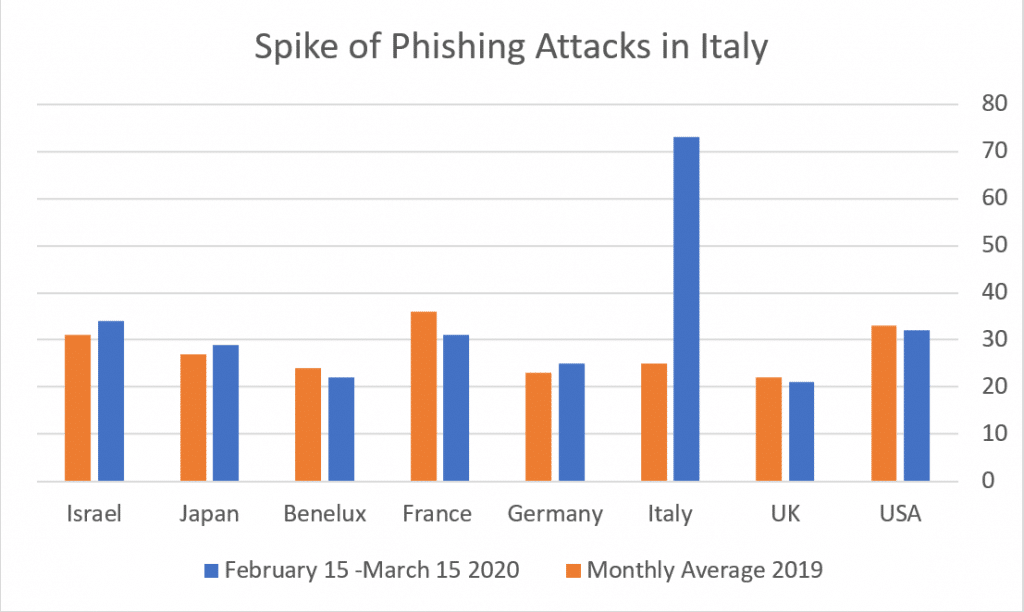
In this image, the orange columns show the average monthly values of phishing attacks suffered by countries in 2019. The blue columns show the phishing attacks that occurred between February 15 and March 15. There is an incredible increase especially in Italy, the reason for this can be thought of as the negligence or unconsciousness of the people there.
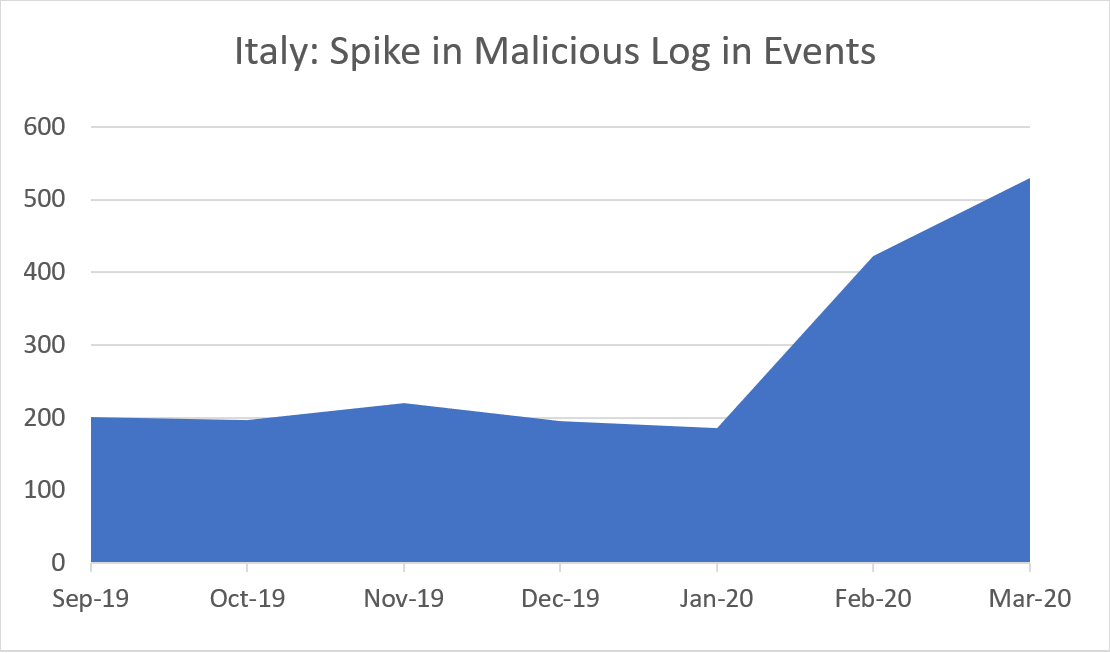
Researchers then conduct research to understand whether the people logging into the systems are real users, and as seen in the graph below, attackers have made many login attempts.
Most people accept content without checking the email. Now I will show you a small graph broken down by the percentage of virus infections through phishing.
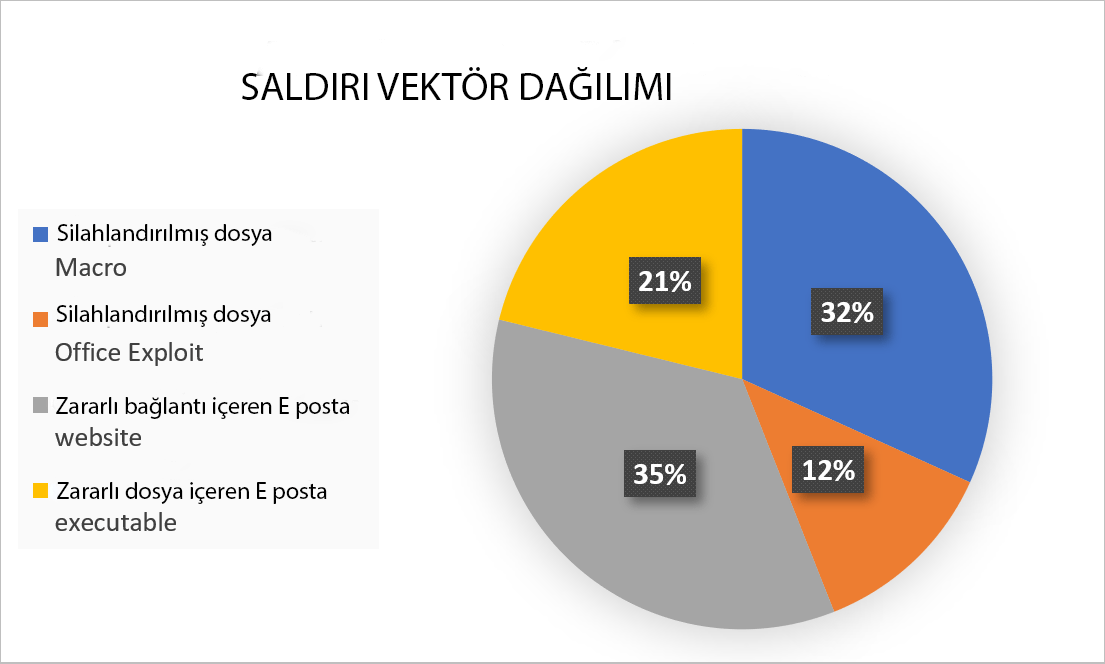
As you can see in this graph, the part formed by malicious emails is quite high. Not clicking on links from malicious emails is not the only solution, as can be understood from the graph. There is a high rate of 21% with executable files found in emails. So is this phishing done only with emails or files as seen in the graph? Of course not. The ads you see on the internet can also be a phishing attack.
Precautions; Be prepared for possible cyber attacks!
Be careful when shopping online. Don't shop from untrusted sites. Don't give your personal information. Especially don't click on links in emails that mention coronavirus. Educate the people you know around you so that we can get out of such a period as a country with the least damage.
Here are a few suggestions to avoid attackers' traps:
- Don't open emails from unknown, unfamiliar sources
- Don't click on links you don't know, don't trust.
- Try to keep your operating systems up to date
- Always use your programs in the latest version
- Never shop from sites you don't trust other than known, familiar sites, this way you will keep both your personal information and your credit card and bank card information largely safe
- Don't use cracked software, While there are security vulnerabilities even in legally licensed products, the probability of security vulnerabilities in cracked, illegally unlicensed, pirated software is higher. They don't crack for free.
- Don't give important permissions such as location, microphone, camera, contacts to sites and applications unless necessary. If it's not trusted, if you have suspicions, don't give permission.
If you have encountered such an attack, you can consult TeknikNokta Data Recovery by phone or email. You can also fill out the request form. Our expert will help you in a short time!