When digital records are what the dispute turns on — deleted files, altered records, copied customer lists, whether an e-mail was really sent — answering those questions takes a technical examination.
An expert opinion is the scientific view a party obtains at its own request; under Article 293 of the Code of Civil Procedure it is filed with the case as evidence. We prepare expert opinions for parties and their counsel: we examine the digital material and deliver the findings, together with the method behind them, in a signed and sealed report.
Court-appointed expert report, or expert opinion?
-
Court-appointed expert report
Assigned by the court or the prosecutor and paid from the case file. The statutory period is three months, extendable once with reasons. Its scope is set by the court's questions.
-
Expert opinion
Commissioned by a party, who sets the scope. Filed with the case as evidence under Article 293. This is the type of report we prepare.
-
What we do
We prepare expert opinions. When you need your technical claim documented, we examine the digital material and report the findings together with the method, the hash verification and the chain of custody.
What makes an opinion strong?
A technical report filed with a court carries weight not through the conclusion it reaches but through how that conclusion was reached. In the opinions we prepare, all seven points below are documented; if one is missing, the report cannot be reviewed.
- Working on an imageThe examination is never carried out on the original device. A bit-for-bit image taken through a write blocker freezes the device as it was at that moment; the original goes back into its enclosure.
- Hash verificationThe digests of the source and of the image are written into the report. Their being identical shows that the examined data is bit-for-bit the same as what was on the device and did not change during the examination.
- A record of tools and versionsThe hardware and software used are listed with their versions. An examination whose method is not written down cannot be repeated by anyone else; a finding that cannot be repeated is open to challenge.
- Chain of custodyWho handed the material over, when, in what packaging, who accessed it and where it was stored are all recorded in the handover documents.
- Staying within scopeOnly the question asked is answered. Subjects left outside the scope are written into the report as well; technical findings and legal characterisation are kept apart.
- Showing the findingEvery finding is given with a screenshot, a file path and a timestamp. A finding described only in prose cannot be reviewed.
- All sources examinedBackups, log records, shadow copies, cloud synchronisation and any second drives are scanned too; the sources examined are listed one by one.
Where no finding emerges, we write that plainly as well. A conclusion the data does not support is of no use to you in your file.
Cases we work on
- Unfair competition and trade secrets
- Dismissal and non-compete disputes
- Data leaks and unauthorised access
- Software and intellectual property disputes
- Accounting and e-ledger records
- Allegations of forged or altered documents
- Damage assessment after ransomware
- Digital records in family law cases
How the examination runs
- Reviewing the caseWe agree together which questions need answering, and say upfront which ones cannot be answered technically.
- Handover of materialDevices or records are collected against a signed record; their condition at handover is documented with photographs and serial numbers.
- Imaging and verificationA bit-for-bit image is taken through a write blocker and the hash values of image and source are compared. The examination runs on the image, never on the original.
- ExaminationDeleted-data recovery, timestamp analysis, registry and log review, keyword searches and file integrity checks.
- ReportingFindings are written up with screenshots and with the method and tools used; the report is delivered in print and digitally.
What the report contains
Our reports follow a standard structure: the subject of the examination and who requested it, identification of the material (make, model, serial number, capacity), the hardware and software used, the imaging record and hash values, the steps applied, the findings and the evidence behind each one, the conclusion and the appendices.
Findings are shown with screenshots and file listings; where no conclusion can be reached, that is stated with reasons. The report is written so that a reader without a technical background can follow it.

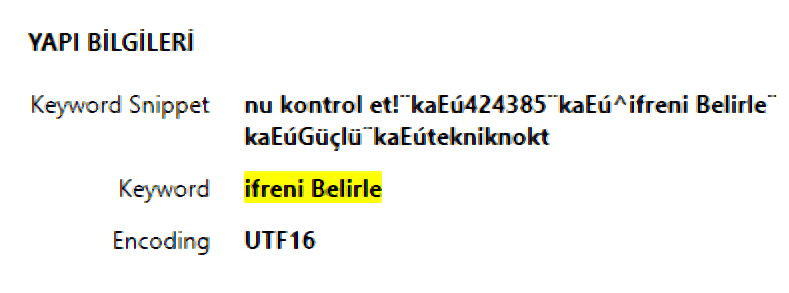
Sections of the report
The opinions we prepare consist of the eight sections below. The structure is not arbitrary: each section carries a piece of information the other side needs in order to review the report.
- Cover and identificationFile number, the court or the requesting party, the name, title and field of the person preparing the report, the date and the report number.
- Request and scopeWhich question was asked, word for word. Subjects left outside the scope are written down as well.
- Material examinedThe make, model, serial number and capacity of each device; the handover date, who it came from, and the state of seals and packaging. The chain of custody begins here.
- Method and toolsWith what hardware and under what write protection the image was taken, and which analysis software and versions were used.
- Hash valuesThe digests of the source and of the image. Their being identical shows that the examination did not alter the original.
- FindingsWhat was found, where it was found and how it was found; screenshots, file paths, timestamps. Interpretation does not enter this section.
- Assessment and conclusionThe technical interpretation of the findings and the answer to the question asked. Where there is uncertainty, it is written down as uncertainty.
- Appendices and signatureHash listings, printouts, handover records; the wet signature and seal of the expert who prepared the report.
In criminal files, searching, copying and seizing data on computers is carried out under Article 134 of the Code of Criminal Procedure; in civil proceedings, a party's opinion rests on Article 293 of the Code of Civil Procedure. We run our examinations in steps that are consistent with that framework and that can be documented.
Laboratory and team
The work is carried out by a team that has been doing data recovery and digital forensics for 19 years, in our own laboratory in Sisli. Faulty or physically damaged devices go first to data recovery — a drive that cannot be read cannot be examined, so having both capabilities under one roof shortens the process.
Our management systems are certified to ISO 9001:2015, ISO/IEC 27001:2013, ISO 14001:2015 and TS EN 15713:2009. Files and devices are kept in an access-restricted area.
Other report types
- Computer Forensics Report
- Reporting of a technical examination carried out on a single device or system.
- E-Ledger Deletion Report
- A statement of facts for the deletion of e-ledger certificates after a cyber attack, failure or data loss.
Frequently asked questions
What is the difference between a court-appointed expert report and an expert opinion?
A court-appointed expert is assigned by the court or the prosecutor and files the report with the case. An expert opinion is the scientific view a party obtains, at its own request, from a specialist of its own choosing, and it is filed as evidence under Article 293 of the Turkish Code of Civil Procedure. We prepare expert opinions at the request of parties and their counsel.
How long does a report take?
Court-appointed experts have a statutory period of three months, extendable once with reasons. For opinions we prepare at a party's request, the time depends on the volume of material and the scope of the examination requested: a single device usually takes a few working days, while multi-device, high-volume files take longer. We confirm the delivery date in writing once the scope is agreed.
Which devices and sources can be examined?
Computer and laptop drives, servers, RAID arrays, NAS devices, USB sticks and memory cards, DVR recorders, accounting and business software databases, and cloud backups. Mobile devices (phones and tablets) are outside our scope.
How should I hand over the device?
You can deliver it to our laboratory in person or by courier, against a signed handover record. It matters that you do not work on the device, do not power it up and down and do not copy files from it: every boot writes new records to the drive and can weaken its evidential value.
Will the report be accepted as evidence in court?
An expert opinion is evidence that can be filed under Article 293; the weight given to it is for the court to decide. What gives a report its weight is how the examination is documented: a bit-for-bit image, hash values of the image and the files written into the report, a documented chain of custody, and findings shown with screenshots.
Can deleted data be part of a report?
Yes. Deleted files, chat records, e-mails and registry traces can often be recovered; and where they cannot, traces of when and by what method the deletion happened can still be written into the report. Where there is no finding, we state that plainly too.
Do you share a sample report or a template?
Instead of a template we publish the whole structure of our reports: the section headed 'Sections of the report' on this page lists all eight sections and explains why each one is needed. What gives a report its weight is not its template but its method: how the image was taken, how the hash value was verified and how the findings were documented. Most of the samples circulating online belong to other fields such as construction, medicine or traffic, and do not fit a digital examination. For work specific to your file, please get in touch.
What is hash verification, and why does it matter so much?
A hash is a fixed-length digest produced from the content of a file or a disk; change a single bit of the content and the digest changes completely. If the digests of the source and of the image taken from it are identical, the examined copy can be shown to be bit-for-bit the same as the original and to have remained unchanged during the examination. If it is not written into the report, that assurance disappears, which is why we record hash values in every opinion.
How is confidentiality handled?
Files and devices are kept in an access-restricted area, the examination is documented, and a non-disclosure agreement is signed with the client or counsel on request. When the work is finished, images and working copies are securely erased unless you ask otherwise in writing.
How is the fee determined?
The fee depends on the number of devices to be examined, the volume of data, the number of questions and the delivery time. After seeing the file we define the scope in writing and quote a fixed price; the price does not change unless the scope does.
Is a supplementary opinion or an explanation at a hearing possible?
Yes. When new material enters the file or further questions are put, a supplementary opinion can be prepared; and where needed, the expert who wrote the opinion can attend a hearing to explain the technical findings.
Tell us about your case
Send us the material you have and the questions you need answered, and we will confirm in writing what is technically possible, how long it will take and what it will cost. Counsel can apply on behalf of a client.
Phone: 0212 916 12 22 · E-mail: info@tekniknokta.com.tr · Contact form
Büyükdere Caddesi, Tevfik Erdönmez Paşa Sokak, Emekli Subay Evleri Blok 15 D 1, Esentepe, Şişli İstanbul