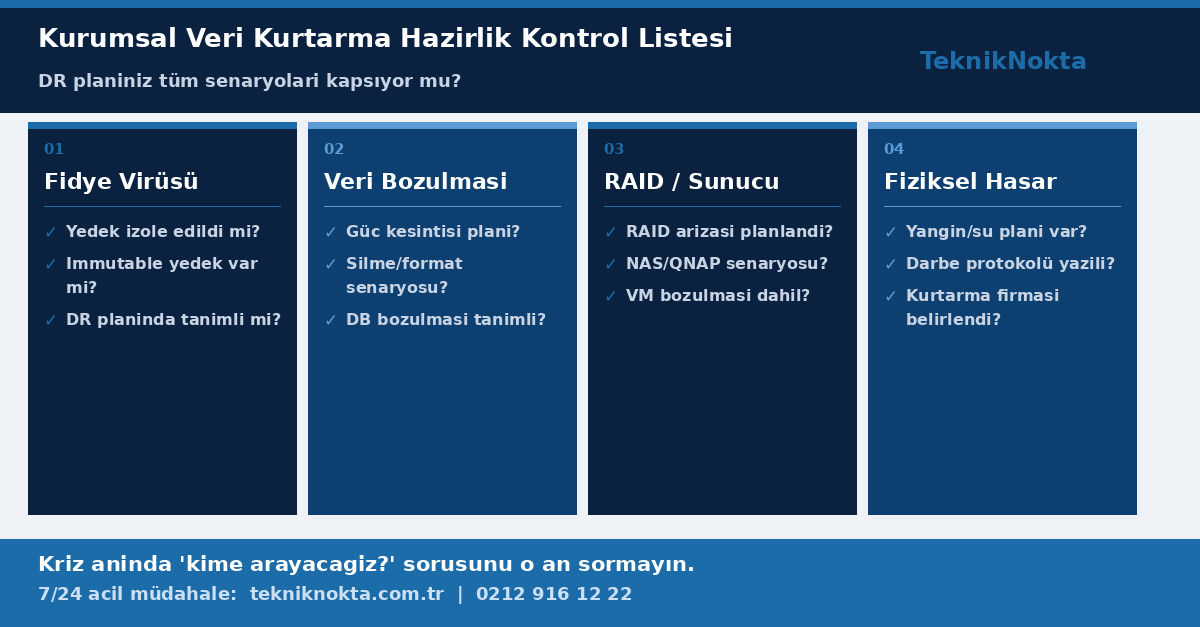
Most corporate IT teams build their disaster recovery (DR) plans on backup. Daily backups, weekly full backups, off-site backup... This structure may look solid in theory, but in practice it hides a serious gap: most DR plans only address two scenarios — system failure and natural disaster. Yet the majority of corporate data loss stems from very different causes.
Most Common Corporate Data Loss Scenarios
In 19 years of experience, reviewing cases from organizations, we see data loss concentrated in four main categories.
1. Ransomware: What If Your Backups Are Encrypted Too?
Modern ransomware also targets network-attached backup systems and encrypts them. The scenario becomes: primary data encrypted, backups encrypted. The option to restore from backup is gone.
What is the next step in your DR plan at this point? Many organizations have no clear answer. The ransomware scenario works differently from classic DR logic — the issue is not just inability to access data, but data that is encrypted and compromised. The step that should kick in here — professional data recovery — is not defined in most DR plans.
2. Data Corruption: The Quietest Threat
Sudden power loss, accidental deletion, formatting, partition loss, or corruption of a critical application's database file... These events may not seem as dramatic as ransomware, but their operational impact can be just as serious.
Database files from ERP, accounting and CRM software stand out in this category. A corrupted MBR or GPT table can cause the entire partition structure to be lost. File system errors after insufficient UPS or sudden shutdown are often an overlooked risk.
3. RAID and Server Failures: Often Outside Business Hours
The most critical feature of RAID arrays is this: when multiple disks fail at once, the array fails completely. With RAID 5, two disks; with RAID 6, three disks failing at the same time — data access is lost. This is not a theoretical scenario — it regularly happens, especially as older disks age together.
Controller failures in NAS and QNAP corporate storage, virtual machine corruption in VMware or Hyper-V environments, and access loss on critical database servers such as SQL Server or Oracle also fall into this category.
4. Physical Damage: Being Caught Unprepared Is Costly
Fire, flood, earthquake or impacts during relocation — recovering data from damaged disks and servers depends largely on the first response. Powering on or trying to run a damaged device often causes irreversible damage.
The golden rule in physical damage scenarios: do not touch the device, do not open it, send it directly to a clean room lab.
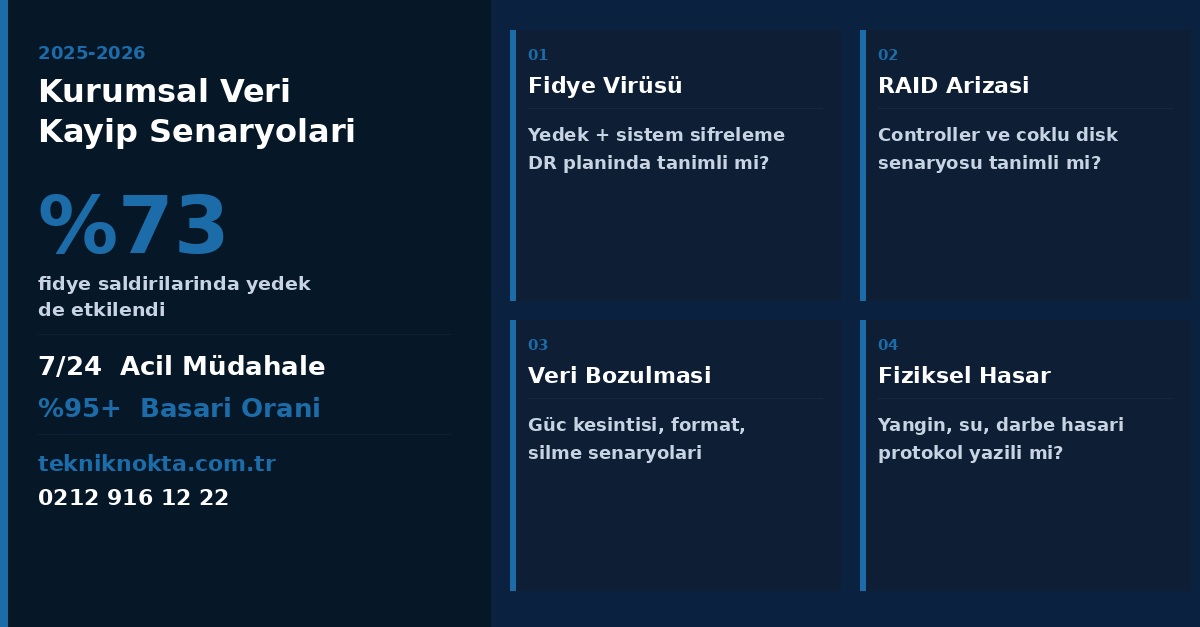
What Might Be Missing in Your DR Plan?
Ask yourself:
- If your backups were also hit in a ransomware attack, what would your next step be?
- If your RAID controller failed, do you have a recovery step for array failure in your plan?
- If a critical server's database were corrupted, could you respond on a weekend?
- Have you pre-selected a firm to contact for damaged equipment?
- Is your recovery priority order written down — which system is recovered first?
If any of these is unclear, there is a gap in your DR plan that needs to be addressed.
Where Should Professional Data Recovery Sit in Your DR Plan?
Data recovery should not be the last resort when there is no backup; it should be a defined step in your DR plan. Deciding in advance which company to contact, which channels to use, and your prioritization criteria shortens response time in a crisis.
This preparation is not only for large enterprises — it is a basic step for any organization that wants to ensure operational continuity.
TeknikNokta: 18 Years of Corporate Data Recovery Experience
Since 2007 we have been providing hard disk, SSD, RAID, NAS and server data recovery services in our ISO-certified clean room lab. We have experience working with organizations from finance, holding and industry sectors, and we move urgent work to the front of the queue.
We do not charge when recovery fails. Every process starts with a free initial analysis.
Frequently Asked Questions
Can data be recovered after a ransomware attack?
How should a data recovery company be included in the DR plan?
Can data be recovered when a RAID array has failed?
Can data be recovered from a physically damaged disk?
How long does data recovery take?
Is there a charge if recovery fails?
Contact us to review your DR plan together or for emergency data recovery support.
Contact or free initial analysis request.
📞 0212 916 12 22 | 🌐 tekniknokta.com.tr | ✉️ info@tekniknokta.com.tr
📄 Download
Download TeknikNokta DR Checklist (PDF)